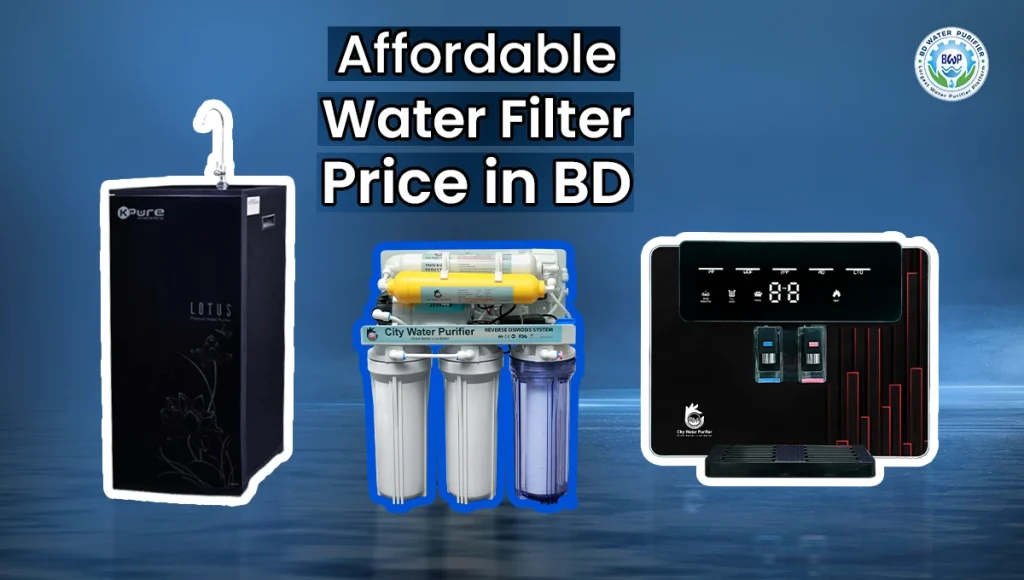
Clean water is essential. In Bangladesh, with varying water quality depending on location, supply, chemical contaminants, or microbiological risks, having a reliable water filter at home isn’t a luxury, it’s a necessity. But “reliable” doesn’t have to mean “expensive.” Let’s explore what affordable water filters cost in Bangladesh in 2025, what kinds are available, and how to choose one that gives you the best value.
Why Safe Drinking Water Matters in Bangladesh
Bangladesh faces critical water quality challenges. Many rural and urban water sources contain contaminants such as arsenic, bacteria, heavy metals, and industrial pollutants. For households, having a reliable water filter is not a luxury. It’s a necessity to protect health.
According to national arsenic mitigation programs, some household-level filters are subsidized to serve lower-income families. Still, many households must bear the cost themselves. In this article, you’ll learn what types of filters are available in Bangladesh, how much they cost, and what to look for when buying one.
Types of Water Filters Are Common (and Affordable)
To choose wisely, it helps to understand the main technologies used in home water filters:
1. Gravity / Non-electric Filters
- These work by letting water pass through sediment, activated carbon, or ceramic media under gravity.
- Pros: No electricity needed, simple maintenance, relatively low cost.
- Cons: Slower rate, limited removal of dissolved contaminants (e.g. heavy metals).
- Price range: Starting as low as ৳4,000–৳5,000 for basic gravity filters.
2. UV + Carbon / Sediment Filters
- Use ultraviolet light to kill bacteria/viruses plus pre-filters to remove particles and odors.
- Pros: Good microbial protection, relatively low cost, minimal water waste.
- Cons: Doesn’t remove dissolved salts or heavy metals. Requires electricity.
3. Ultrafiltration (UF)
- Employs ultra-fine membranes to block bacteria, colloids, and larger molecules.
- Pros: Good for bacterial viruses, moderate cost, moderate maintenance.
- Cons: Doesn’t remove dissolved solids (TDS), not ideal for high-salinity water.
4. Reverse Osmosis (RO)
- Most comprehensive for dissolved salts, heavy metals, and chemicals. Water is forced through TFC membranes.
- Pros: Very high purity water.
- Cons: Higher cost, requires electricity, wastes water, frequent membrane/filter replacement.
5. Hybrid Systems (RO + UV + UF + Alkaline / Mineral stages)
- Combine multiple technologies to improve taste, add minerals, or purify broadly.
- The more stages, the higher cost and maintenance.
Price Range of Water Filters in Bangladesh?
Here’s a snapshot of current market offerings in Bangladesh to help you anchor expectations:
| Type / Tier | Example & Price | Notes |
| Basic gravity / non-electric | Some models start around ৳7,000 at BD Water Purifier for simple non-electric filters | Good for rural, low-power settings |
| Hollow Tech brand (6-stage) | ~ ৳7,000 (discounted) | More advanced non-RO/UF hybrid |
| Mid-range household RO / UF systems | Examples from BD Water Purifier website list “alkaline water purifiers” in range ৳11,500 to ৳13,500 | Balanced performance for urban homes |
| Premium multi-stage RO systems | City Water Purifier lists a 6-stage hot–cold–normal RO for ~ ৳14,500 | For homes needing many features |
| Brands like Pureit (basic models) | Pureit “Classic GKK (1500 L)” listed ~ ৳800 on Pureit Bangladesh site (likely a cartridge or small unit) | Entry-level component / small unit |
| Local arsenic filters (government / NGO) | Government household-level arsenic filter sold under DART program in past between ৳3,500–৳5,000 | Targeted to areas with arsenic contamination |
Frequently Asked Questions (FAQ)
Q: Can a filter under ৳5,000 ensure safe drinking water?
Ans: It depends on what contaminants are present. For microbes, UV/UF or good gravity filters can help. But for dissolved solids or heavy metals, more advanced systems (RO or specialty membranes) are needed.
Q: What is TDS and do I need to reduce it?
Ans: TDS (total dissolved solids) includes minerals, salts, metals in water. If TDS is high (e.g. >300–500 ppm), taste and health concerns may arise. RO systems can reduce TDS.
Q: Does RO waste water?
Ans: Yes — many RO units discard more water than they produce. Look for “recovery rate” specifications; some newer ones waste less.
Q: Are locally made parts reliable?
Ans: Many local filters and membranes are reliable if they adhere to quality standards. Always check user reviews, warranty, and whether replacements are available locally.
Q: Can these filters remove arsenic from groundwater?
Ans: Some specialized arsenic removal filters (e.g. those distributed via DART) are designed for that. Regular RO systems may remove some arsenic, but not guaranteed unless certified.
Q: Does the filter work if there’s a power cut?
Ans: Gravity or non-electric systems do; most RO systems won’t work when there’s no power, unless they have a stored tank to continue supplying filtered water for a limited time.
Q: How to maintain my water filter?
Ans: Clean the outer unit, flush regularly, sanitize periodically, replace cartridges and membranes as needed, service annually if possible.
Conclusion
Finding an affordable water filter in Bangladesh doesn’t mean compromising safety or quality, it means being smart about your needs, contamination levels, and long-term costs. For many households, a mid-budget filter in the ৳7,000–৳15,000 range, with good maintenance and service, offers the sweet spot of safety and affordability.
Once you narrow down your water quality (via testing) and budget, you can choose between gravity, UF/UV, or RO systems each with its pros and cons. Always check for local servicing, cartridge availability, and realistic long-term costs.